History and cultural impact
The wendigo legend exists in the oral history of North American tribes
predating Europeans’ arrival in North America. Some anthropologists
believe the legend developed as a cautionary tale about the importance
of community to guard against individual greed, selfishness, and
isolation. The wendigo was a personification of cold and hunger in a
time when human survival relied on banding together and sharing
resources, particularly during the long, harsh winters of the northern
wilderness. The legend may also have served as a warning to children
not to wander too far into the woods.
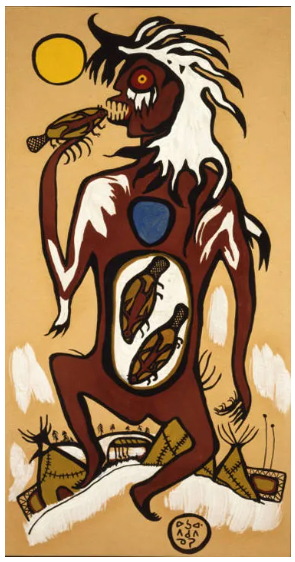
The first known written mention of the wendigo appears in a 1636
report by Paul Le Jeune, a French Jesuit missionary living among the
Algonquin people in what is now Quebec. Le Jeune described a woman who
warns of an atchen that had eaten some tribal members nearby and that
“would eat a great many more of them if he were not called
elsewhere.”
A few instances of murder and cannibalism in North America were blamed
on the wendigo. These included a case in Alberta, Canada (1879), where
a Cree hunter and trapper named Swift Runner claimed a wendigo spirit
had entered his dreams and told him to eat his family. He was tried
for murder, found guilty, and hanged for his crimes later that year.
Another case occurred in 1907 among the Sandy Lake First Nation
community in northern Ontario. The tribal shaman, Jack Fiddler, and
his brother, Joseph Fiddler, were charged with the murder of Joseph’s
daughter-in-law, whom they had strangled to prevent her from becoming
possessed by a wendigo. After the brothers’ arrest, Jack Fiddler
escaped the police and strangled himself, and Joseph Fiddler died from
tuberculosis in prison in 1909.
By the early 20th century, the term wendigo psychosis was being used
by psychologists and missionaries to describe a culture-bound syndrome
among Native and First Nations people whose symptoms included
delusions of becoming possessed by an evil spirit, depression,
violence, a compulsion for human flesh, and, in some cases,
cannibalism. The syndrome was also diagnosed retroactively in
historical cases of cannibalism in North America. However, the
existence of the syndrome is disputed by some scientists.
For centuries Indigenous artists and activists have drawn on the
wendigo legend both literally and metaphorically to address such
issues as colonialism, violence, and environmental destruction.
American writer Louise Erdrich’s poem “Windigo” (1984) tells of a man
trapped inside a windigo who abducts a young girl, who in turn
releases his spirit. Her novel The Round House (2012), which centres
on an Ojibwe boy in North Dakota seeking justice after his mother is
raped, uses the wendigo legend to explore views of retribution and
justice among the boy’s tribe versus those of the U.S. government. In
the 21st century, activist Winona LaDuke coined the term Wendigo
economics to criticize corporations’ “cannibalistic” effect on
Earth.
Since the 19th century, the wendigo legend has also captured the
imagination of non-Indigenous authors. In The Wilderness Hunter
(1893), the future U.S. president Theodore Roosevelt includes a
“goblin story” about a bearlike beast that stalks the camp of two
hunters, leaving only one to survive and tell the tale. Readers have
interpreted Roosevelt’s beast as being either the legendary Bigfoot or
a wendigo. British writer Algernon Blackwood’s novella The Wendigo
(1910) tells a similar story of a mysterious monster hunting a
campsite in the Canadian wilderness, and American novelist Stephen
King features a wendigo in the horror story Pet Sematary (1983).
Canadian writer Margaret Atwood examines the wendigo legend in Strange
Things: The Malevolent North in Canadian Literature (1995), a book of
lectures on the imaginative landscape of Canadian literature.