Kraken

Hundreds of years ago, sailors were terrified by the Kraken, a dreadful sea monster capable of sinking ships and with a taste for human flesh. Today we know the legends of this monster were based on sightings of giant squids. This animal belongs to the genus Architeuthis and was the subject of many scientific studies. Despite its enormous size (up to 18m), the giant squid is astoundingly elusive and much of its biology remains unknown. Thus shrouded in mystery, Architeuthis is almost a mythological creature and has a place both in science and in myth: the very last of the legends to persist to this day.

karken
Description and Folklore

Norse legend said that the Kraken was the largest monster to haunt the seas. Its name seems to have come from the German word for ''dragon,'' and King Sverre of Norway first recorded the Kraken in 1180. The Kraken was said to be as large as an island and to swim in the waters surrounding Norway, Greenland, and Iceland. The Kraken either used its large arms to attack ships or would create currents to drown ships. Terrified sailors who said the Kraken had a taste for humans and would devour an entire ship's crew may have exaggerated its appearance. karken2

Kraken, the subject of sailors' superstitions and mythos, was first described in the modern era in a travelogue by Francesco Negri in 1700. This description was followed in 1734 by an account from Dano-Norwegian missionary and explorer Hans Egede, who described the kraken in detail and equated it with the hafgufa of medieval lore.

However, the first description of the creature is usually credited to the Norwegian bishop Pontoppidan (1753). Pontoppidan was the first to describe the kraken as an octopus (polypus) of tremendous size,[b] and wrote that it had a reputation for pulling down ships. The French malacologist Denys-Montfort, of the 19th century, is also known for his pioneering inquiries into the existence of gigantic octopuses.

The great man-killing octopus entered French fiction when novelist Victor Hugo (1866) introduced the pieuvre octopus of Guernsey lore, which he identified with the kraken of legend. This led to Jules Verne's depiction of the kraken, although Verne did not distinguish between squid and octopus.

The legend of the Kraken may have originated from sightings of giant squid, which may grow to 12–15 m (40–50 feet) in length.

Linnaeus may have indirectly written about the kraken. Linnaeus wrote about the Microcosmus genus (an animal with various other organisms or growths attached to it, comprising a colony). Subsequent authors have referred to Linnaeus's writing, and the writings of Bartholin's cetus called hafgufa, and Paullini's monstrous marinum as "krakens".

That said, the claim that Linnaeus used the word "kraken" in the margin of a later edition of Systema Naturae has not been confirmed.

For the first navigators, the sea was a great unknown, treacherous, unstable, and above all, dangerous; yet, it was the only way to reach certain places. For these men, the sea seemed to hide in its inconceivable depths a horde of lurking monsters. Even the bravest seafarers showed a respectful dread of the sea, and the stories they told gradually became legends, for, as the saying goes, “the tale grows in the telling.” An encounter with any unknown animal in the open sea had the potential to gain a mythological edge. For a monster worthy of its tales, gigantic size was not enough; it should also have some means to attack a ship and kill its crew.

Over the centuries, many sea monster legends were born and forgotten; only a few have reached our days. The Kraken, one of these “survivors,” is perhaps the largest monster ever imagined by mankind. Its legend was also born from seamen’s stories, but it was much modified and strengthened over the years. Right from the start, the Kraken was universally incorporated into Nordic mythology and folklore (Hamilton, 1839). According to an obscure, ancient manuscript of circa 1180 by King Sverre of Norway, the Kraken was just one of many sea monsters (Lee, 1883). Still, it had its own peculiarities: it was colossal in size, as large as an island, and capable of sinking ships; it haunted the seas between Norway and Iceland, and between Iceland and Greenland (Lee, 1883).

Two other Nordic sea monsters have records almost as old as the Kraken, appearing in the “Saga of Örvar-Oddr” (an Icelandic story from the thirteenth century by an anonymous author); their names are Hafgufa (“sea-mist”) and Lyngbakr (“heather-back”). The habits of theses monsters were later described in the Norwegian encyclopedia Konungs Skuggsjá (from circa 1250, also by an anonymous author). They shared many features with the Kraken, namely their gigantic size (as big as an island or mountain) and their inclination to attack ships and their crews. Therefore, these monsters have been considered as references to the Kraken and are treated as the same monster.

However, nearly all sea monsters had some (or all) of these traits, and as such many of them were linked to or confused with (or, to borrow the lexicon of taxonomy, “placed in synonymy with”) the Kraken over the centuries. Their features only reflected the fears of the first navigators, and the Kraken proved to be the strongest figure in their folklore, dragging every other sea monster under its shadow. The other monsters included the Aspidochelone (or Fastitocalon), a creature also similar to an island; possibly the bishop-fish (also known as the sea bishop, sea monk or monk-fish), a sea monster whose legend might also have originated from encounters with seals, sharks or walruses; and, finally, even the biblical Leviathan.

This confusion of creatures explains why the Kraken is found under so many guises in art and literature, from a misshapen mass to a giant cephalopod, passing through creatures as distinct as a humanoid sea giant, a huge, usually lobster-like, crustacean, and a sea serpent (Magnus, 1555; Gesner, 1587; Ashton, 1890). It was only much later that the Kraken’s figure stabilized. Until the beginning of the eighteenth century, science and myth were not clearly separated, and the Kraken slowly but steadily took on the shape of a giant cephalopod, largely due to the increase in the number of sightings of giant squids as seafaring became more common. This culminated in the Kraken’s “modern” form as a giant squid, which can be understood as a return to the animal that long ago originated the legend.

History and cultural impact

Before actually examining the science behind the monster, it is worth lingering a little more in the domain of mythology and further exploring the Kraken in all its legendary glory. First of all, it should be noted that although “Kraken” is the commonest name found in the literature, the monster answers to many other variants: Krake, Krabben, Kraxen, Skykraken and Crab-fish (Pontoppidan, 1752, 1752-1753;Wallenberg, 1835; Lee, 1883; Hamilton, 1839; Matthews, Matthews, 2005).
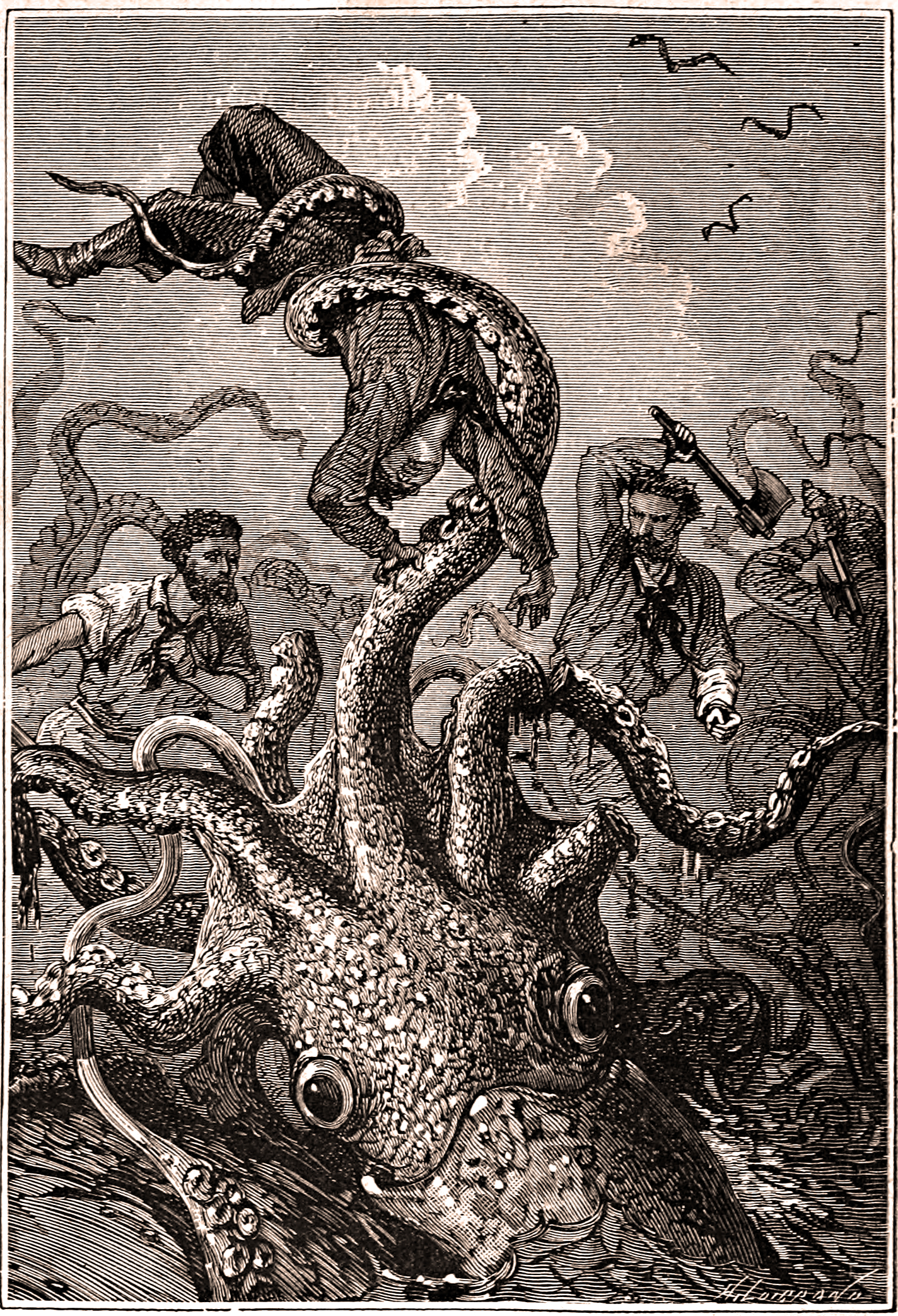
The Kraken’s colossal size initially reached a few kilometers in length (Pontoppidan, 1752, 1752-1753; Wallenberg, 1835), but as the legend matured and took its molluscan shape, it was progressively diminished to more modest proportions. Of course, even this smaller Kraken was still large enough to attack and sink a ship (Figure 1), and its ability to do so is the commonest theme in its stories, reflecting sailors’ fears. There are many accounts in the pseudoscientific and cryptozoological literature, and also in the official naval records, telling of encounters with the monster (e.g., Pontoppidan, 1752, 1752-1753; Hamilton, 1839; Ashton, 1890). They report that the Kraken would attack a ship with its strong arms, and if this strategy failed it could sink a vessel by creating a fierce maelstrom that could drag the ship to the bottom of the ocean. This is the most recurrent “ability” attributed to the Kraken in the literature, and it is found with some variations. Generally, it was thought that the Kraken would start swimming in circles around the ship (which clearly implies a much smaller size for the monster), thus creating the deadly vortex. However, when a larger size was attributed to the Kraken, the monster could create a maelstrom simply by submerging, and the helpless ship would be dragged down even if that was not the monster’s original intent (Pontoppidan, 1752, 1752-1753).

Naturally, a monster would not be regarded as such if it did not have a certain taste for human flesh. Legends say that the Kraken was capable of eating a ship’s entire crew; some even claim that the creature could devour the crew of an entire fleet at once. It is also worth mentioning the most curious piece of folklore about the Kraken: the belief that the amber (fossilized tree resin) found on the beaches of the North Sea was the monster’s excrement (Matthews, Matthews, 2005).

Despite its fearsome reputation, the Kraken could also bring some benefits for people. Sailors believed that the monster swam accompanied by huge schools of fishes, telling how fishes cascaded down the Kraken’s back when it emerged from the sea (Wallenberg, 1835). Some claimed that fishes ate the monster’s excrement while others said that the Kraken produced some sort of “aroma” to attract its fish prey. Putting their fear aside, some fishermen risked going near the monster in order to secure a more bounteous catch.

Besides the myth, the Kraken was also immortalized in art, and two of its appearances deserve special attention. The first is the poem “The Kraken” by Alfred Lord Tennyson (1830), a sonnet where the author combines mythology (with strong references to the biblical Leviathan) and natural history (Thomson, 1986). The second, the novel Twenty thousand leagues under the sea by Jules Verne (1870), is better known (Figure 2): the monster, called simply “poulpe” (octopus) in the French original, attacks the crew of the Nautilus submarine (curiously, the name of another cephalopod).

Ellis (2004) has managed to gather a large amount of information about sea monsters and their zoological counterparts. In his research, he encountered many people who actually believed that the giant squid was only a myth and were really surprised to discover a real animal behind the legends. It seems the Kraken is still very much alive in folklore, even after so many centuries and so much research. The monster has gained a new lease of life since the 1940s due to its sporadic appearance in pop culture: in movies (e.g. Pirates of the Caribbean: dead man’s chest, 2006), fictional literature (e.g.Kraken, by China Miéville, 2010), videogames (e.g. Age of mythology, 2002, and Assassin’s creed III, 2012), comic books (mainly in some stories by DC Comics and Marvel Comics) and even music (in the song “Architeuthis”, the heavy metal band Tourniquet appropriately defines the animal as the last living mystery).

The first memorable movie starring the Architeuthis was Reap the wild wind (1942), which, as stated by Ellis (2004), defined what the public would come to expect of the giant squid: a monster lurking in sunken ships waiting for reckless divers. Another striking appearance of the Kraken is in Walt Disney Studio’s adaptation ofTwenty thousand leagues under the sea (1954). An interesting case is the movie Clash of the Titans, both the original version (1981) and its recent remake (2010), where the error mentioned earlier can be seen. In this movie, the Kraken appears as a gigantic humanoid monster, taking the place of Cetus in the Greek legend of Princess Andromeda, and therefore inserted in a mythology that has absolutely nothing to do with it.

The most outstanding appearance of the giant squid in the fictional literature isBeast (1991), a novel by Peter Benchley, author ofJaws. As is usual in such stories, the monster goes about killing everyone for no reason whatsoever until it is finally killed in the end. The way Benchley shows the giant squid, as a merciless and vengeful killing machine, drew the attention of Arthur C. Clarke, a renowned science fiction author and great admirer of Architeuthis (the animal had already been featured in many of his short stories). Clarke, as well as many other writers and scientists, believed Benchley’s novel Jaws and its movie adaptation were responsible for the ruthless hunting and killing of white sharks which took place shortly after the movie was released; as such, they feared that the same could happen with Architeuthis after Beast (Clarke, 1992). Fortunately, that never happened, certainly because the giant squid is extremely hard to find (and unpalatable due to the ammonium in its muscles) and not because people had suddenly developed greater environmental awareness. For now, the giant squid apparently is not in danger. However, as technology advances, it is possible that these animals will be more easily caught; therefore, maybe in the near future, Architeuthiswill need protection or it will definitely become a myth.Architeuthis is an emblematic animal and may even be used as a symbol for environmental protection (Guerra et al., 2011).

Movies

Pirates of the Caribbean

Dead Man's Chest

Recommend