Werewolf

The werewolf is a mythological animal and the subject of many stories throughout the world—and more than a few nightmares. Werewolves are, according to some legends, people who morph into vicious, powerful wolves. Others are a mutant combination of human and wolf. But all are bloodthirsty beasts who cannot control their lust for killing people and animals. It’s unclear exactly when and where the werewolf legend originated. Some scholars believe the werewolf made its debut in The Epic of Gilgamesh, the oldest known Western prose, when Gilgamesh jilted a potential lover because she had turned her previous mate into a wolf. Werewolves made another early appearance in Greek mythology with the Legend of Lycaon. According to the legend, Lycaon, the son of Pelasgus, angered the god Zeus when he served him a meal made from the remains of a sacrificed boy. As punishment, the enraged Zeus turned Lycaon and his sons into wolves. Werewolves also emerged in early Nordic folklore. The Saga of the Volsungs tells the story of a father and son who discovered wolf pelts that had the power to turn people into wolves for ten days. The father-son duo donned the pelts, transformed into wolves and went on a killing rampage in the forest. Their rampage ended when the father attacked his son, causing a lethal wound. The son only survived because a kind raven gave the father a leaf with healing powers. Many so-called werewolves from centuries ago were in fact serial killers, and France had its fair share. In 1521, Frenchmen Pierre Burgot and Michel Verdun allegedly swore allegiance to the devil and claimed to have an ointment that turned them into wolves. After confessing to brutally murdering several children, they were both burned to death at the stake. (Burning was thought to be one of the few ways to kill a werewolf.)
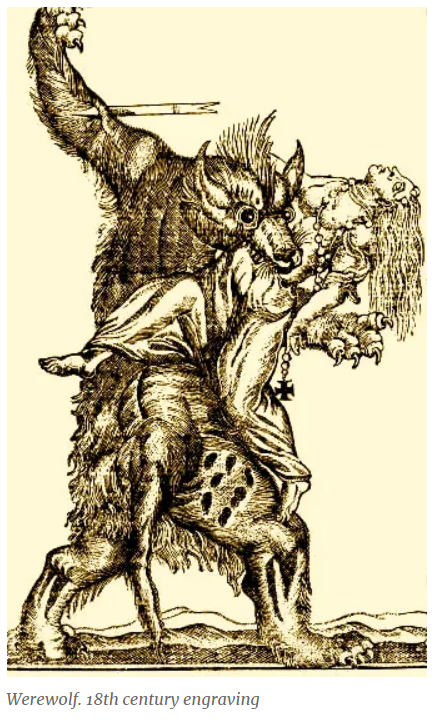
werewolf
Description and folklore

In folklore, a werewolf (from Old English werwulf 'man-wolf'), or occasionally lycanthrope (from Ancient Greek λυκάνθρωπος, lukánthrōpos, 'wolf-human') is an individual werewolf2 who can shape-shift into a wolf (or, especially in modern film, a therianthropic hybrid wolf-like creature), either purposely or after being placed under a curse or affliction (often a bite or the occasional scratch from another werewolf), with the transformations occurring on the night of a full moon. Early sources for belief in this ability or affliction, called lycanthropy, are Petronius (27–66) and Gervase of Tilbury (1150–1228).

The werewolf is a widespread concept in European folklore, existing in many variants, which are related by a common development of a Christian interpretation of underlying European folklore developed during the medieval period. From the early modern period, werewolf beliefs also spread to the New World with colonialism. Belief in werewolves developed in parallel to the belief in witches, in the course of the Late Middle Ages and the early modern period. Like the witchcraft trials as a whole, the trial of supposed werewolves emerged in what is now Switzerland (especially the Valais and Vaud) in the early 15th century and spread throughout Europe in the 16th, peaking in the 17th and subsiding by the 18th century.

The persecution of werewolves and the associated folklore is an integral part of the "witch-hunt" phenomenon, albeit a marginal one, accusations of lycanthropy being involved in only a small fraction of witchcraft trials. During the early period, accusations of lycanthropy (transformation into a wolf) were mixed with accusations of wolf-riding or wolf-charming. The case of Peter Stumpp (1589) led to a significant peak in both interest in and persecution of supposed werewolves, primarily in French-speaking and German-speaking Europe. The phenomenon persisted longest in Bavaria and Austria, with persecution of wolf-charmers recorded until well after 1650, the final cases taking place in the early 18th century in Carinthia and Styria.

After the end of the witch-trials, the werewolf became of interest in folklore studies and in the emerging Gothic horror genre; werewolf fiction as a genre has pre-modern precedents in medieval romances (e.g. Bisclavret and Guillaume de Palerme) and developed in the 18th century out of the "semi-fictional" chapbook tradition. The trappings of horror literature in the 20th century became part of the horror and fantasy genre of modern popular culture.

History and cultural impact

The European motif of the devilish werewolf devouring human flesh harks back to a common development during the Middle Ages in the context of Christianity, although stories of humans turning into wolves take their roots in earlier pre-Christian beliefs. Their underlying common origin can be traced back to Proto-Indo-European mythology, where lycanthropy is reconstructed as an aspect of the initiation of the kóryos warrior class, which may have included a cult focused on dogs and wolves identified with an age grade of young, unmarried warriors. The standard comparative overview of this aspect of Indo-European mythology is McCone (1987).

A few references to men changing into wolves are found in Ancient Greek literature and Folklore. Herodotus, in his Histories, wrote that the Neuri, a tribe he places to the north-east of Scythia, were all transformed into wolves once every year for several days, and then changed back to their human shape. This tale was also mentioned by Pomponius Mela.

In the second century BC, the Greek geographer Pausanias related the story of King Lycaon of Arcadia, who was transformed into a wolf because he had sacrificed a child in the altar of Zeus Lycaeus. In the version of the legend told by Ovid in his Metamorphoses, when Zeus visits Lycaon disguised as a common man, Lycaon wants to test if he is really a god. To that end, he kills a Molossian hostage and serve his entrails to Zeus. Disgusted, the god turns Lycaon into a wolf. However, in other accounts of the legend, like that of Apollodorus' Bibliotheca, Zeus blasts him and his sons with thunderbolts as punishment.

Pausanias also relates the story of an Arcadian man called Damarchus of Parrhasia, who was turned into a wolf after tasting the entrails of a human child sacrificed to Zeus Lycaeus. He was restored to human form 10 years later and went on to become an Olympic champion. This tale is also recounted by Pliny the Elder, who calls the man Demaenetus quoting Agriopas. According to Pausanias, this was not a one-off event, but that men have been transformed into wolves during the sacrifices to Zeus Lycaeus since the time of Lycaon. If they abstain of tasting human flesh while being wolves, they would be restored to human form nine years later, but if they don't abstain they will remain wolves forever.

Lykos (Λύκος) of Athens was a wolf-shaped herο, whose shrine stood by the jurycourt, and the first jurors were named after him.

Pliny the Elder likewise recounts another tale of lycanthropy. Quoting Euanthes, he mentions that in Arcadia, once a year a man was chosen by lot from the Anthus' clan. The chosen man was escorted to a marsh in the area, where he hung his clothes into an oak tree, swam across the marsh and transformed into a wolf, joining a pack for nine years. If during these nine years he refrained from tasting human flesh, he returned to the same marsh, swam back and recovered his previous human form, with nine years added to his appearance. Ovid also relates stories of men who roamed the woods of Arcadia in the form of wolves.

Virgil, in his poetic work Eclogues, wrote about a man called Moeris, who used herbs and poisons picked in his native Pontus to turn himself into a wolf. In prose, the Satyricon, written circa AD 60 by Gaius Petronius Arbiter, one of the characters, Niceros, tells a story at a banquet about a friend who turned into a wolf (chs. 61–62). He describes the incident as follows, "When I look for my buddy I see he'd stripped and piled his clothes by the roadside... He pees in a circle round his clothes and then, just like that, turns into a wolf!... after he turned into a wolf he started howling and then ran off into the woods."

Early Christian authors also mentioned werewolves. In The City of God, Augustine of Hippo gives an account similar to that found in Pliny the Elder. Augustine explains that "It is very generally believed that by certain witches spells men may be turned into wolves..." Physical metamorphosis was also mentioned in the Capitulatum Episcopi, attributed to the Council of Ancyra in the 4th century, which became the Church's doctrinal text in relation to magic, witches, and transformations such as those of werewolves. The Capitulatum Episcopi states that "Whoever believes that anything can be...transformed into another species or likeness, except by God Himself...is beyond doubt an infidel.

In these works of Roman writers, werewolves often receive the name versipellis ("turnskin"). Augustine instead uses the phrase "in lupum fuisse mutatum" (changed into the form of a wolf) to describe the physical metamorphosis of werewolves, which is similar to phrases used in the medieval period.

Movies

Supernatural

Season-2 Episode-17

Van Helsing

Recommend