History and cultural impact
The exact origins of belief in jinn are not entirely clear. Belief in
jinn in the pre-Islamic Arab religion is testified not only by the
Quran, but also by pre-Islamic literature in the seventh century. Some
scholars of the Middle East hold that they originated as malevolent
spirits residing in deserts and unclean places, who often took the
forms of animals; others hold that they were originally pagan nature
deities who gradually became marginalized as other deities took
greater importance. Since the term jinn seems to be not of Arabic, but
of Aramaic origin, denoting demonized pagan deities, the jinn probably
entered Arabian belief in the late pre-Islamic period. Still, jinn had
been worshipped by many Arabs during the Pre-Islamic period, though,
unlike gods, jinn were not regarded as immortal. Emilie Savage-Smith,
who asserted that jinn are malevolent in contrast to benevolent gods,
does not hold this distinction to be absolute, admitting jinn-worship
in pre-Islamic Arabia. In the regions north to the Hejaz, Palmyra and
Baalbek, the terms jinni and ilah were often used interchangeably.
Julius Wellhausen likewise states that in pre-Islamic Arabia it was
assumed there are friendly and helpful beings among the jinn. He
asserts that the distinction between a god and a jinni is, the jinn
are worshipped in private while the gods are worshipped in public.
Although their mortality ranks them lower than gods, it seems that the
veneration of jinn had played more importance in the everyday life of
pre-Islamic Arabs than the gods themselves. According to common
Arabian belief, soothsayers, pre-Islamic philosophers, and poets were
inspired by the jinn. Their culture and society were analogous to that
pre-Islamic Arabian culture, having tribal leaders, protecting their
allies and avenging murder for any member of their tribe or allies.
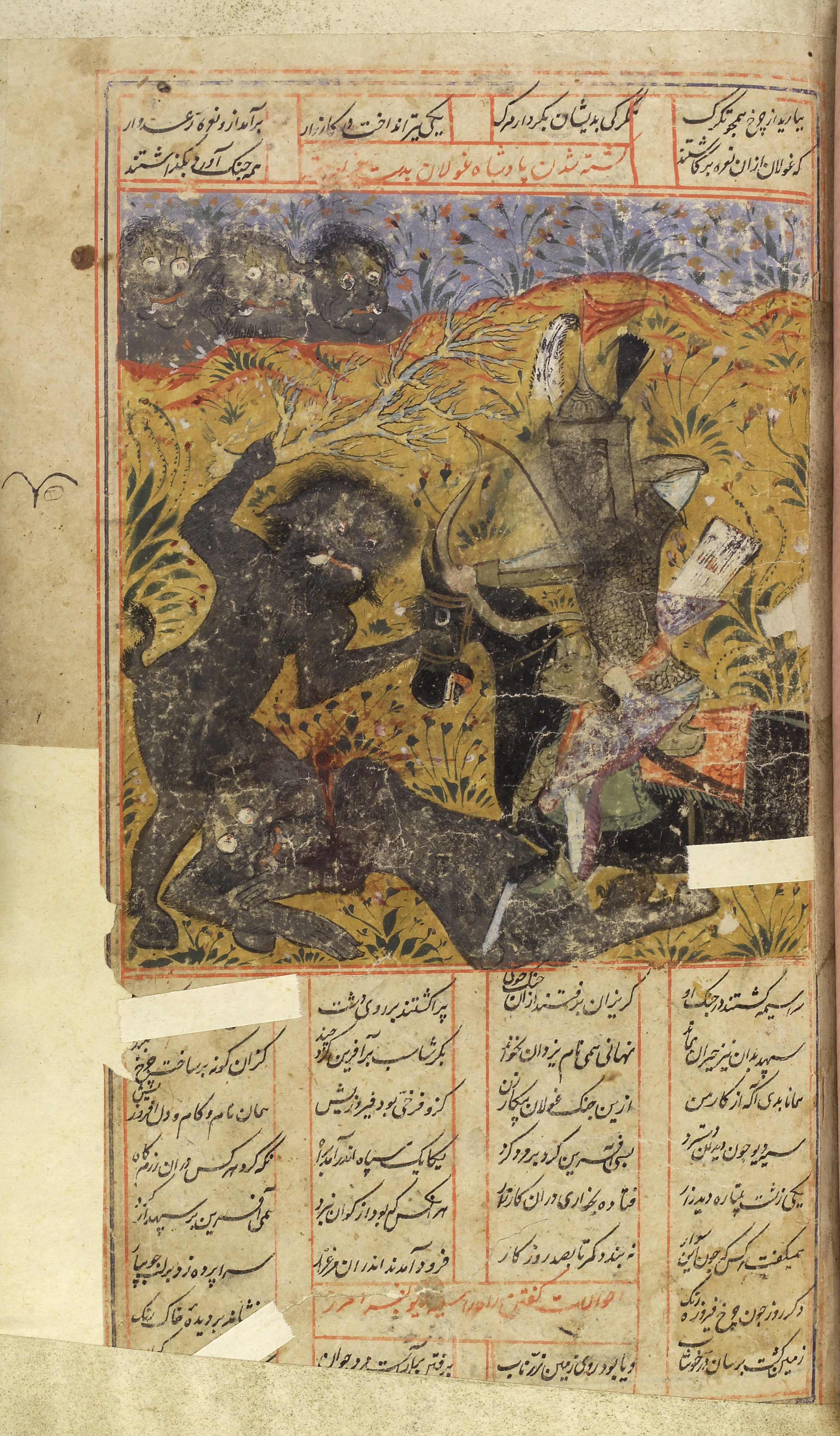
Although the powers of jinn exceed those of humans, it is conceivable
a man could kill a jinni in single combat. Jinn were thought to shift
into different shapes, but were feared especially in their invisible
form, since then they could attack without being seen. Jinn were also
feared because they had been thought to be responsible for various
diseases and mental illnesses. Julius Wellhausen observed that such
spirits were thought to inhabit desolate, dingy, and dark places and
that they were feared. One had to protect oneself from them, but they
were not the objects of a true cult. Al-Jahiz credits the pre-Islamic
Arabs with believing that the society of jinn constitutes several
tribes and groups and some natural events were attributed to them,
such as storms. They also thought jinn could protect, marry, kidnap,
possess, and kill people. Despite that they were often feared or they
inspired awe, the jinn were also pictured to have romantic feelings
for humans. According to a famous pre-Islamic story, the jinni Manzur
fell in love with a human woman called Habbah, teaching her the arts
of healing.
Some scholars argue that angels and devils were introduced by the
Islamic prophet Muhammad to Arabia and did not exist among the jinn.
On the other hand, Amira el-Zein argues that angels were known to the
pagan Arabs, but the term jinn was used for all kinds of supernatural
entities among various religions and cults; thus, Zoroastrian,
Christian, and Jewish angels and devils were conflated with jinn.
Jinn are mentioned literally 32 times in the Quran, and as an
individual by name as "Iblees" 11 times, and as the devil and
passively many more times than that. By that, the Quran confirms their
existence to Muslims, but does not elaborate on them any further. In
Islamic tradition, Muhammad was sent as a prophet to both human and
jinn communities, and that prophets and messengers were sent to both
communities. Traditionally, the 72nd surah, Al-Jinn, named after them,
is held to tell about the revelation to jinn and several stories
mention one of Muhammad's followers accompanied him, witnessing the
revelation to the jinn.
The Quran condemns pre-Islamic practice of worshipping jinn for means
of protection. The Quran reduced the status of jinn from that of
tutelary deities to that of minor spirits, usually paralleling humans.
They are, like humans, rational beings formed of nations . Surah 51:56
resumes that both jinn and humans were created to worship God. Surah
6:130 states that God has sent messengers to both humans and jinn.
Individuals among both communities are held accountable for their
deeds, and will be punished or rewarded in the afterlife, in
accordance with their deeds. It is impossible for both jinn and humans
to approach God both physically and mentally.
Unlike humans, jinn are not vicegerents of the earth. Al-Baqara only
credits Adam as a successor (khalifa). However, some exegetes, like
Tabari, argue that jinn inherited the world before, and that when
angels complain about God creating humans who "will shed blood", they
link humans to the jinn who ruled the earth previously.
In the story of Solomon, it is implied that the jinn live on the earth
alongside humans. Solomon is granted dominion over humans, ants, birds
and jinn. The jinn served him as soldiers and builders of the First
Temple. According to the Quran, when Solomon died, the jinn have not
recognized that his soul left his body until he fell on the ground.
This is understood to be proof that the jinn, despite being generally
invisible themselves, do not know the unseen (Al-Ghaib).
The jinn are also mentioned in collections of canonical hadiths.
According to the reports of the hadiths, the jinn eat like humans, but
instead of fresh food, they prefer rotten flesh and bones. Another
hadith advises to close doors and keep children close at night for the
jinn go around and snatch things away. One hadith divides them into
three groups, with one type of jinn flying through the air; another
that are snakes and dogs; and a third that moves from place to place
like human. This account parallels the jinn to humans, similar to the
Quran, as another hadith divides humans into three groups, with one
kind which is like four-legged beast, who are said to remain ignorant
of God's message; a second one which is under the protection of God;
and a last one with the body of a human, but the soul of a devil
(shaitan).
A famous, yet weak (da'if), hadith narrates that ibn Masud accompanied
Muhammad to a lecture to the jinn somewhere in the mountains. Muhammad
would have drawn a line around ibn Masud and commanded him not to
leave the circle. Then ibn Masud watched Muhammad being surrounded by
silhouettes and he was afraid that Muhammad would be attacked by his
enemies. Remembering Muhammad's words, he decided not to intervene.
When Muhammad returned, he told ibn Masud that, if he had left his
place, he would have been killed by these jinn.