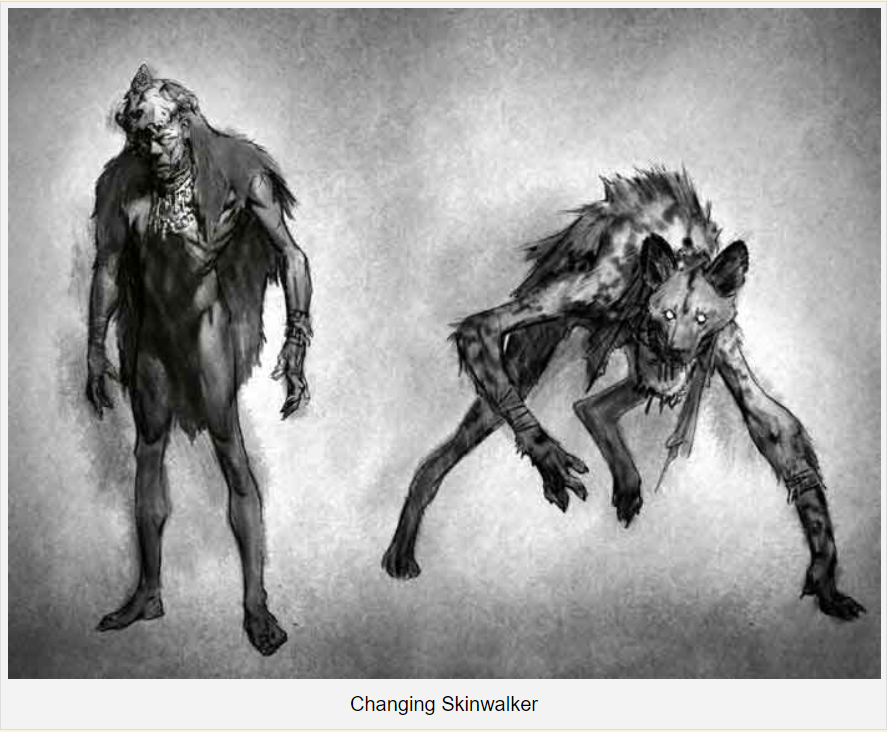
Skinwalker

The Skinwalker is an ancient Native American legend that takes on various forms across tribes. In Navajo lore, a skin-walker ( yee naaldlooshii) is a kind of wicked sorcerer who can transform into, occupy, or disguise themselves as an animal. The myth behind this shapeshifting being known as the Skinwalker has mostly been consigned the label of either hoax, too much peyote, or simply oral traditions transfixed to a culture’s beliefs. The Navajo Skinwalker nevertheless has deep roots in aboriginal American folklore. Other tribes throughout the region also have their own version of the Skinwalker. The Pueblo people, Apache, and Hopi each have their own unique interpretation of what a skinwalker might be.

Skin-walker
Background

In the Navajo language, yee naaldlooshii translates to "by means of it, it goes on all fours". While perhaps the most common variety seen in horror fiction by non-Navajo people, the yee naaldlooshii is one of several varieties of skin-walkers in Navajo culture; specifically, they are a type of 'ánti'įhnii. skinwalker2

Navajo witches, including skin-walkers, represent the antithesis of Navajo cultural values. While community healers and cultural workers are known as medicine men and women, or by other positive terms in the community's Indigenous language, witches are seen as evil, performing harmful ceremonies and manipulative magic in a perversion of the good works medicine people traditionally perform. In order to practice their good works, traditional healers may learn about both good and evil magic, in order to protect against evil. But people who choose to become witches are seen as corrupt.

The legend of the skin-walkers is not well understood outside of Navajo culture, both due to reluctance to discuss the subject with outsiders, as well as what Cherokee Nation academic Adrienne Keene says is a lack of the necessary cultural context the stories are embedded within. Traditional Navajo people are reluctant to reveal skin-walker lore to non-Navajos, or to discuss it at all among those they do not trust. Keene, founder of the website Native Appropriations, has written in response to non-Navajos incorporating the legends into their writing (and specifically the impact when J. K. Rowling did so) that when this is done, "We as Native people are now opened up to a barrage of questions about these beliefs and traditions...but these are not things that need or should be discussed by outsiders. At all. I'm sorry if that seems 'unfair', but that's how our cultures survive."

Legend

Skinwalkers are most frequently seen as coyotes, wolves, foxes, eagles, owls or crows and are not creatures to be trusted. Some Navajo believe that skinwalkers have the ability to steal the face of a person, and some believe that if one ever locks eyes with a skinwalker they can absorb themselves into a person's body, or that one's body might freeze up with fear, allowing a skinwalker to channel that fear to gain power and energy. A skinwalker can transform into any animal by first wearing a pelt of the animal in order to properly transform into said animal. Similar lore can be found in cultures throughout the world and is often referred to as shapeshifting by anthropologists. Because it is believed that skinwalkers wear the skins of the animals they transform into, it is considered taboo to wear the pelt of any animal. In fact, the Navajo are only known to wear two hides, sheepskin and buckskin, both of which are only used for ceremonial purposes.

Animals associated with witchcraft usually include tricksters such as the coyote; however, it may include other creatures, usually those associated with death or bad omens. They might also possess living animals or people and walk around in their bodies. Skin-walkers may be male or female. Skin-walker stories told among Navajo children may be complete life and death struggles that end in either skin-walker or Navajo killing the other, or partial encounter stories that end in a stalemate. Encounter stories may be composed as Navajo victory stories, with the skin-walkers approaching a hogan and being scared away.

Non-Native interpretations of skin-walker stories typically take the form of partial encounter stories on the road, where the protagonist is temporarily vulnerable, but then escapes from the skin-walker in a way not traditionally seen in Navajo stories. Sometimes Navajo children take European folk stories and substitute skin-walkers for generic killers like The Hook.

Movies

Supernatural

Season-6 Episode-8

Recommend