History and cultural impact
Many of the indigenous cultures across the North American continent
include tales of mysterious hair-covered creatures living in forests,
and according to anthropologist David Daegling, these legends existed
long before contemporary reports of the creature described as Bigfoot.
These stories differed in their details regionally and between
families in the same community, and are particularly prevalent in the
Pacific Northwest.
On the Tule River Indian Reservation, petroglyphs created by a tribe
of Yokuts at a site called Painted Rock are alleged by some to depict
a group of Bigfoot called "the Family". The local tribespeople call
the largest of the glyphs "Hairy Man", and they are estimated to be
between 500 and 1000 years old. 16th century Spanish explorers and
Mexican settlers told tales of the los Vigilantes Oscuros, or "Dark
Watchers", large creatures alleged to stalk their camps at night. In
the region that is now Mississippi, a Jesuit priest was living with
the Natchez in 1721 and reported stories of hairy creatures in the
forest known to scream loudly and steal livestock.
Ecologist Robert Pyle argues that most cultures have accounts of
human-like giants in their folk history, expressing a need for "some
larger-than-life creature". Each language had its name for the
creature featured in the local version of such legends. Many names
mean something along the lines of "wild man" or "hairy man", although
other names described common actions that it was said to perform, such
as eating clams or shaking trees. Chief Mischelle of the Nlaka'pamux
at Lytton, British Columbia told such a story to Charles Hill-Tout in
1898.
The Sts'ailes people tell stories about sasq'ets, a shapeshifting
creature that protects the forest. The name "Sasquatch" is the
anglicized version of sasq'ets (sas-kets), roughly translating to
"hairy man" in the Halq'emeylem language.
Members of the Lummi tell tales about creatures known as Ts'emekwes.
The stories are similar to each other in the general descriptions of
Ts'emekwes, but details differed among various family accounts
concerning the creature's diet and activities. Some regional versions
tell of more threatening creatures: the stiyaha or kwi-kwiyai were a
nocturnal race and children were warned against saying the names so
that the "monsters" would not come and carry them off to be killed.
The Iroquois tell of an aggressive, hair covered giant with rock-hard
skin known as the Ot ne yar heh or "Stone Giant", more commonly
referred to as the Genoskwa. In 1847, Paul Kane reported stories by
the natives about skoocooms, a race of cannibalistic wild men living
on the peak of Mount St. Helens. U.S. President Theodore Roosevelt, in
his 1893 book, The Wilderness Hunter, writes of a story he was told by
an elderly mountain man named Bauman in which a foul-smelling, bipedal
creature ransacked his beaver trapping camp, stalked him, and later
became hostile when it fatally broke his companion's neck. Roosevelt
notes that Bauman appeared fearful while telling the story, but
attributed the trapper's German ancestry to have potentially
influenced him.
Less menacing versions have been recorded, such as one by Reverend
Elkanah Walker in 1840. Walker was a Protestant missionary who
recorded stories of giants among the natives living near Spokane,
Washington. These giants were said to live on and around the peaks of
the nearby mountains, stealing salmon from the fishermen's nets.
On July 16, 1924, an article in The Oregonian made national news when
a story was published describing a conflict between a group of gold
prospectors and a group of "ape-men" in a gorge near Mount St. Helens.
The prospectors reported encountering "gorilla men" near their remote
cabin. One of the men, Fred Beck, indicated that he struck one of the
creatures with rifle fire. That night, they reported coming under
attack by the creatures, who were said to have thrown large rocks at
the cabin, damaging the roof and knocking Beck unconscious. The men
fled the area the following morning. The U.S. Forest Service
investigated the site of the alleged incident. The investigators found
no compelling evidence of the event and concluded it was likely a
fabrication. Stories of large, hair covered bipedal ape-men or
"mountain devils" had been a persistent piece of folklore in the area
for centuries prior to the alleged incident. Today, the area is known
as Ape Canyon and is cemented within Bigfoot-related folklore.
One study was conducted by John Napier and published in his book
Bigfoot: The Yeti and Sasquatch in Myth and Reality in 1973. Napier
wrote that if a conclusion is to be reached based on scant extant
"'hard' evidence," science must declare "Bigfoot does not exist."
However, he found it difficult to entirely reject thousands of alleged
tracks, "scattered over 125,000 square miles" (325,000 km2) or to
dismiss all "the many hundreds" of eyewitness accounts. Napier
concluded, "I am convinced that Sasquatch exists, but whether it is
all it is cracked up to be is another matter altogether. There must be
something in north-west America that needs explaining, and that
something leaves man-like footprints."
In 1974, the National Wildlife Federation funded a field study seeking
Bigfoot evidence. No formal federation members were involved and the
study made no notable discoveries. Also in 1974, the now defunct North
American Wildlife Research Team constructed a "Bigfoot trap" in the
Rogue River–Siskiyou National Forest. It was baited with animal
carcasses and captured multiple bears, but no Bigfoot. Upkeep of the
trap ended in the early 1980s, but in 2006 the United States Forest
Service repaired the trap, which today is a tourist destination along
the Collings Mountain hiking trail.
Beginning in the late 1970s, physical anthropologist Grover Krantz
published several articles and four book-length treatments of Bigfoot.
However, his work was found to contain multiple scientific failings
including falling for hoaxes.
A study published in the Journal of Biogeography in 2009 by J.D.
Lozier et al. used ecological niche modeling on reported sightings of
Bigfoot, using their locations to infer preferred ecological
parameters. They found a very close match with the ecological
parameters of the American black bear. They also note that an upright
bear looks much like a Bigfoot's purported appearance and consider it
highly improbable that two species should have very similar ecological
preferences, concluding that Bigfoot sightings are likely
misidentified sightings of black bears.
In the first systematic genetic analysis of 30 hair samples that were
suspected to be from Bigfoot-like creatures, only one was found to be
primate in origin, and that was identified as human. A joint study by
the University of Oxford and Lausanne's Cantonal Museum of Zoology and
published in the Proceedings of the Royal Society B in 2014, the team
used a previously published cleaning method to remove all surface
contamination and the ribosomal mitochondrial DNA 12S fragment of the
sample. The sample was sequenced and then compared to GenBank to
identify the species origin. The samples submitted were from different
parts of the world, including the United States, Russia, the
Himalayas, and Sumatra. Other than one sample of human origin, all but
two are from common animals. Black and brown bears accounted for most
of the samples, other animals include cow, horse, dog/wolf/coyote,
sheep, goat, deer, raccoon, porcupine, and tapir. The last two samples
were thought to match a fossilized genetic sample of a 40,000 year old
polar bear of the Pleistocene epoch; a second test identified the
hairs as being from a rare type of brown bear.
In 2019, the FBI declassified an analysis it conducted on alleged
Bigfoot hairs in 1976. Bigfoot researcher Peter Byrnes sent the FBI 15
hairs attached to a small skin fragment and asked if the bureau could
assist him in identifying it. Jay Cochran, Jr., assistant director of
the FBI's Scientific and Technical Services division responded in 1977
that the hairs were of deer family origin.
Bigfoot has a demonstrable impact in popular culture, and has been
compared to Michael Jordan as a cultural icon. October 20, the
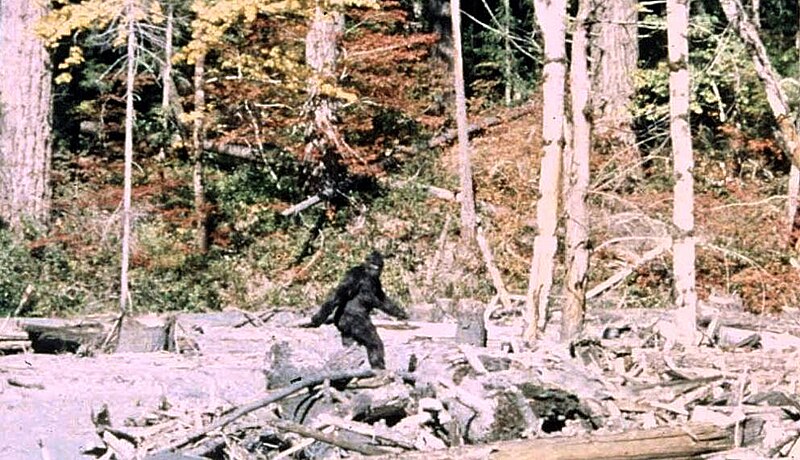
anniversary of the Patterson-Gimlin film recording, is considered by
some as "National Sasquatch Awareness Day". In 2018, Smithsonian
magazine declared "Interest in the existence of the creature is at an
all-time high". According to a poll taken in May 2020, about 1 in 10
American adults believe that Bigfoot is a real animal. The creature
has inspired the naming of a medical company, music festival,
amusement park ride, monster truck, a Marvel Comics superhero and
more. Two National Basketball Association teams located in the Pacific
Northwest have used Bigfoot as a mascot; Squatch of the now-defunct
Seattle SuperSonics from 1993 until 2008, and Douglas Fur of the
Portland Trail Blazers as of 2023.[248] Legend the Bigfoot was
selected as the official mascot for the 2022 World Athletics
Championships being held in Eugene, Oregon.
Laws and ordinances exist regarding harming or killing a Bigfoot,
specifically in the state of Washington. In 1969 in Skamania County, a
law was passed making killing a Bigfoot punishable by a felony
conviction resulting in a monetary fine up to $10,000 or five years
imprisonment. In 1984, the law was amended to a misdemeanor and the
entire county was declared a "Sasquatch refuge". Whatcom County
followed suit in 1991, declaring the county a "Sasquatch Protection
and Refuge Area". In 2022, Grays Harbor County, Washington, passed a
similar resolution after a local elementary school in Hoquiam
submitted a classroom project asking for a "Sasquatch Protection and
Refuge Area" to be granted. In 2021, Rep. Justin Humphrey, in an
effort to bolster tourism, proposed an official Bigfoot hunting season
in Oklahoma, indicating that the Wildlife Conservation Commission
would regulate permits and the state would offer a $3 million bounty
if such a creature was captured alive and unharmed.
In 2015, World Champion taxidermist Ken Walker completed what he
believes to be a lifelike Bigfoot model based on the subject in the
Patterson–Gimlin film. He entered it into the 2015 World Taxidermy &
Fish Carving Championships in Springfield, Missouri and was the
subject of Dan Wayne's 2019 documentary Big Fur.
Some have been critical of Bigfoot's rise to fame, arguing that the
appearance of the creatures in cartoons, reality shows, and
advertisements further reduces the potential validity of serious
scientific research. Others propose that society's fascination with
the concept of Bigfoot stems from human interest in mystery, the
paranormal, and loneliness. In a 2022 article discussing recent
Bigfoot sightings, journalist John Keilman of the Chicago Tribune
states, "As UFOs have gained newfound respect, becoming the subject of
a Pentagon investigative panel, the alleged Bigfoot sighting is a
reminder that other paranormal phenomena are still out there,
entrancing true believers and amusing skeptics".
In the 2018 podcast Wild Thing, creator and journalist Laura Krantz
argues that the concept of Bigfoot can be an important part of
environmental interest and protection, stating, "If you look at it
from the angle that Bigfoot is a creature that has eluded capture or
hasn't left any concrete evidence behind, then you just have a group
of people who are curious about the environment and want to know more
about it, which isn't that far off from what naturalists have done for
centuries". Bigfoot has been used in official government environmental
protection campaigns, albeit comedically, by entities such as the U.S.
Forest Service in 2015.
The act of searching for or researching the creatures is often
referred to as "Squatching" or "Squatch'n", popularized by the Animal
Planet series, Finding Bigfoot. Bigfoot researchers and believers are
often called "Squatchers".